
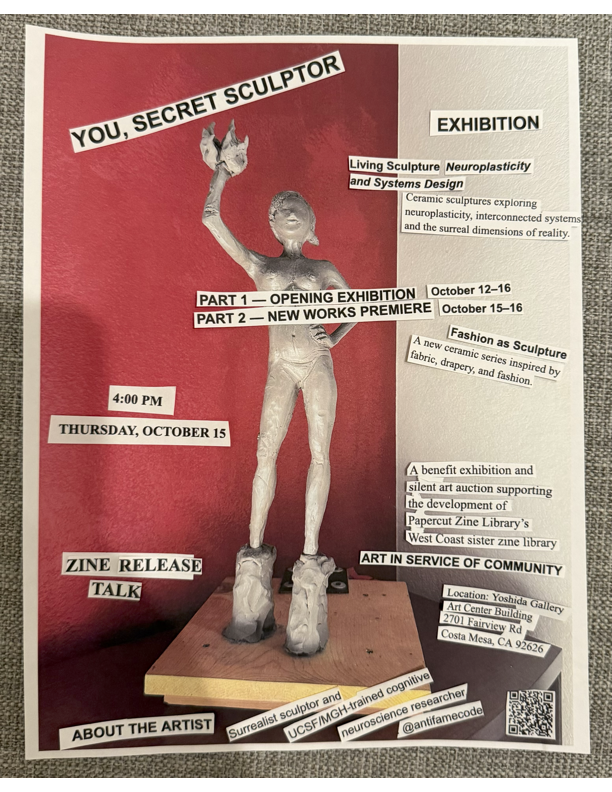
YOU<-- SECRET SCULPTOR
OCT 15th, 2026
4pm
Yoshida Gallery
YOU, SECRET SCULPTOR is a benefit exhibition and silent art auction featuring surreal ceramic works exploring neuroplasticity, interconnected systems, and fashion as sculpture. Join us to celebrate art, community, and the development of our West Coast sister zine library. In collaboration with @antifamecode.
Are you interested in an applied neuroplasticity workshop? Let us know and we’ll host a free workshop.
Express your interest here.
Can’t attend YOU, SECRET SCULPTOR but would like to support the library? Donate here.
YOU, SECRET SCULPTOR
An introductory toolkit for applied neuroplasticity
An exhibition companion to Yoshida Gallery, featuring 16 surreal sculptures by Star // ANTI FAME CODE.
Your brain remains capable of change throughout life. Not every change is beneficial, and change is not entirely within our control. The invitation is to understand what shapes us—and become more intentional about what we practice, notice, and surround ourselves with.
“No space is neutral.”
— Anita Honkanen, MD
Brains, Bodies, and Buildings: Neuro-Architecture and the Spaces That Shape Us
Stanford course attended Spring of 2026.
Five sculptures. Five ways to change your perspective.
01 — Train Your Attention
THE DISCOVERY: Trauma can make threat feel ever-present. Noticing safety, connection, and positive experiences may help broaden attention without denying pain.
THE PRACTICE: Pause. Find one moment of comfort, beauty, or connection. Let yourself notice it.
Key terms: PTSD = post-traumatic stress disorder. PTG = post-traumatic growth following adversity. Trigger = cue associated with distress. Glimmer = informal term for a cue of safety or connection.
Research: NIMH — PTSD · Post-traumatic growth research
02 — Know What Changes Your Brain
THE DISCOVERY: Benzodiazepines enhance GABA-A receptor activity to reduce anxiety and arousal. With prolonged use, the brain adapts; physical dependence, tolerance, and difficult withdrawal can follow. Some people report debilitating symptoms lasting months or years after stopping.
These adaptations involve changes in receptor function and neural signaling—not simply the brain stopping GABA production. The extent of lasting neurological effects and the course of recovery remain incompletely understood.
THE PRACTICE: Before starting or continuing treatment, ask about dependence, long-term risks, alternatives, and a discontinuation plan. Abrupt stopping can cause life-threatening seizures. Never stop suddenly; seek medical guidance for an individualized taper.
Key terms: GABA = a major inhibitory neurotransmitter. Physical dependence = physiological adaptation that can cause withdrawal. Protracted withdrawal = symptoms persisting beyond acute withdrawal.
Research: FDA boxed warning · 2025 tapering guideline · Review of long-term neurological effects
03 — Move to Change How You Feel
THE DISCOVERY: Muscle is more than machinery: contracting muscles release signaling molecules that communicate with other organs, while physical activity supports mood and cognitive health.
THE PRACTICE: Walk, stretch, or dance for ten minutes. Start where you are; notice what shifts.
Key terms: Myokines = signaling molecules released by muscle. Somatic practices = approaches using movement and body awareness to support regulation.
Research: WHO physical activity guidelines · Exercise and muscle–brain signaling
04 — Design Your Experience
THE DISCOVERY: Your brain continually interprets the world through sensory input and prior expectations. Light, sound, play, and repeated daily cues help shape how you experience your surroundings—and what captures your attention.
THE PRACTICE: Change one cue in your day: seek natural light, play music, explore something unfamiliar, or interrupt an automatic thought with a deliberate pause.
Key terms: Predictive processing = using prior expectations to interpret incoming information. Neurodesign = neuroscience-informed design. Meta-neurodesign = our proposed term for intentionally shaping the cues, routines, and environments that influence daily experience.
Research: Predictive processing · Music and well-being
05 — Check the Hardware
THE DISCOVERY: Your mind does not operate in isolation. Sleep, nutrition, illness, medication, hormones, and gut–brain communication can all influence how you feel and function. Sometimes what feels psychological also has a physical contributor.
THE PRACTICE: Each day, check your basic needs: Have I slept, eaten enough, hydrated, moved, and connected with someone? Persistent low mood deserves attention to both physical and psychological health.
Key terms: Gut–brain axis = two-way communication between the digestive system and brain. Human systems engineering = designing systems around human needs and limitations. Most bodily serotonin is produced in the gut, but peripheral serotonin does not cross the blood–brain barrier.
Research: Gut–brain axis review · Human factors engineering
When you feel low: a five-minute reset
Check your body: Sleep, food, hydration, pain, illness, and medication effects.
Shift your state: Get daylight, move gently, or take a few comfortable breaths.
Redirect attention: Notice one thing that feels safe, meaningful, or manageable.
Reconnect: Message someone you trust or ask for support.
Seek help: Persistent or severe depression warrants professional assessment; it is not a personal failure.
These steps can support well-being, but they are not a substitute for medical care.
The guiding idea: Understand what shapes you. Care for the body that supports you. Design your surroundings with intention. Practice the experiences you want to cultivate.
An evidence-informed public education toolkit—not a validated clinical protocol. Neuroplasticity creates opportunities for adaptation, not a guarantee that every change is beneficial.
<3 Star
Interested in a neuroplasticity workshop?
We’re exploring both remote and in-person formats— let us know which you prefer.
We’d also love your feedback on this zine. What sparked your curiosity? What would you like to explore next?
A PZL / AFC BICOASTAL COLLABORATION
Created alongside YOU, SECRET SCULPTOR, an exhibition of 16 surreal sculptures by Star // ANTI FAME CODE at Yoshida Gallery. Inspired in part by the Stanford course Brains, Bodies, and Buildings: Neuro-Architecture and the Spaces That Shape Us, attended earlier this year.
An invitation to stay curious about the brain, the body, and the possibilities of change.